It started in an office I was visiting, with a piece of mid-century American modern art that looked like it came straight off the set of Mad Men: floating Mondrian-style tiles and lines, calm and orderly. I wanted to try that idea with a warmer palette. As I sketched it on a small canvas, I started to think about why the composition soothed me. It invites me in to relax and let my mind wander and rest.
Drawing on the Right Side of the Brain
It also sent me back to Betty Edwards’ 1979 book, Drawing on the Right Side of the Brain. Every freshman in my SCAD foundations year had a copy, because every foundations professor pushed us to read it. That was the year we all found out we weren’t the only ones in the pond with artistic skill. The book goes deeper than the memory it sparked, but what stayed with me was the joy of learning that my brain had two halves. Each half was an expert at looking at things differently, and together they could surround an idea or a problem.
Design and Art
SCAD also taught me the difference between design and art. Design follows a set of rules you choose in order to solve something specific. Art exists for its own sake: to explore, confront, inspire, or change. It makes its own rules, and only the artist knows whether he is keeping them or breaking them to follow an interesting side quest. Sometimes a painting’s real value isn’t the finished piece. The best ones open a door the artist hadn’t found yet.
The Right Side
That’s where the right-hand canvas came in. Our eyes mirror each other, and so does the composition. But the right side doesn’t follow the opposite of the left side’s rules. Its edges are softer, and its spaces are rounder, more inviting places to sit with a new idea and feel more than one thing at once.
The pair isn’t a contest between the two sides. It’s a thank-you for the way we’re made: with at least two ways to see every problem, journey, or opportunity, and so a better understanding of the whole. Art does that for us, and with us.
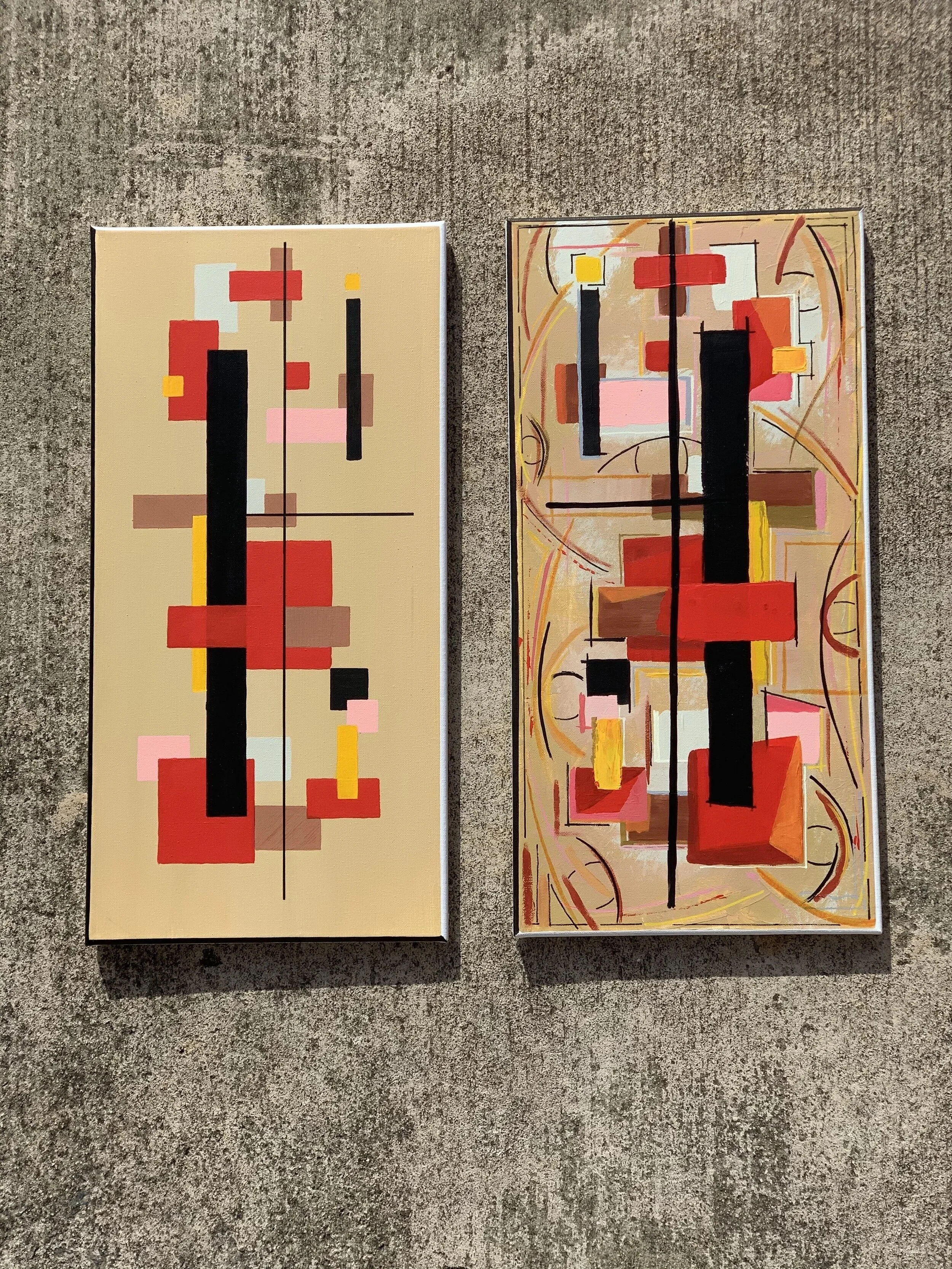
Two Sides to My Brain · Acrylic diptych on wrapped canvas · 10 × 20 × ¾ in. · c. 2021